
Full-Funnel Thinking: Why GTM Requires More Than Great Specialists
What most teams get wrong

There’s a pattern I’ve seen across nearly every company I’ve worked with. Leads are coming in, but pipeline quality is inconsistent. Marketing is hitting their lead targets, sales is running their playbook, and somehow the business still isn’t growing the way it should.
The underlying issue is almost always the same: each function optimizes for their own metric, while the outcome the business actually needs gets lost in the gap. It’s not a talent problem. It’s a structure problem.
In this article, I’ll cover the three principles behind a better approach, why most companies default to patterns that undermine it, and what it looks like in practice. Anyone not interested in reading the full article can find a summary here.
Three Principles That Have to Work Together
Most GTM advice treats these as separate levers. In my experience, they’re a chain, and if one link is weak, the others don’t hold.
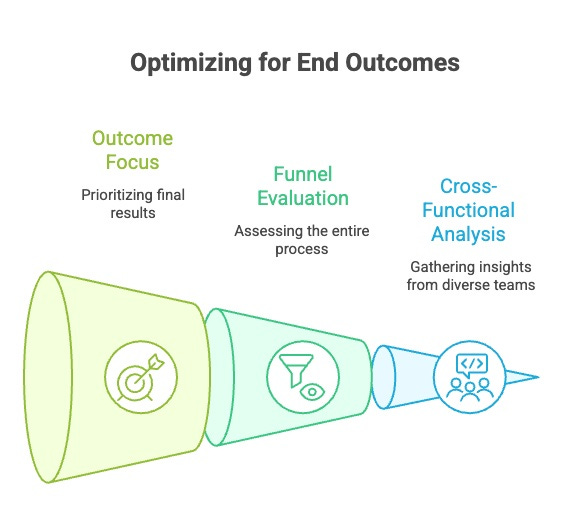
1. Optimize for end outcomes, not intermediate metrics: Marketing and sales should both be goaled on closed revenue and ROI. When they’re not playing the same game, misalignment becomes the root of most dysfunction. Lead volume and lead quality are often poorly correlated, and without someone holding the full funnel accountable, systems get gamed in ways that look like success on a dashboard but quietly undermine the business.
2. Think cross-functionally: Misaligned goals remove the incentive to collaborate. Marketing thinks: once the lead is captured, my job is done. Sales thinks: these leads are low quality, I’ll do my own prospecting. Nobody asks what data we could share to make each other better, or where prospects are dropping off and who is responsible for fixing it.
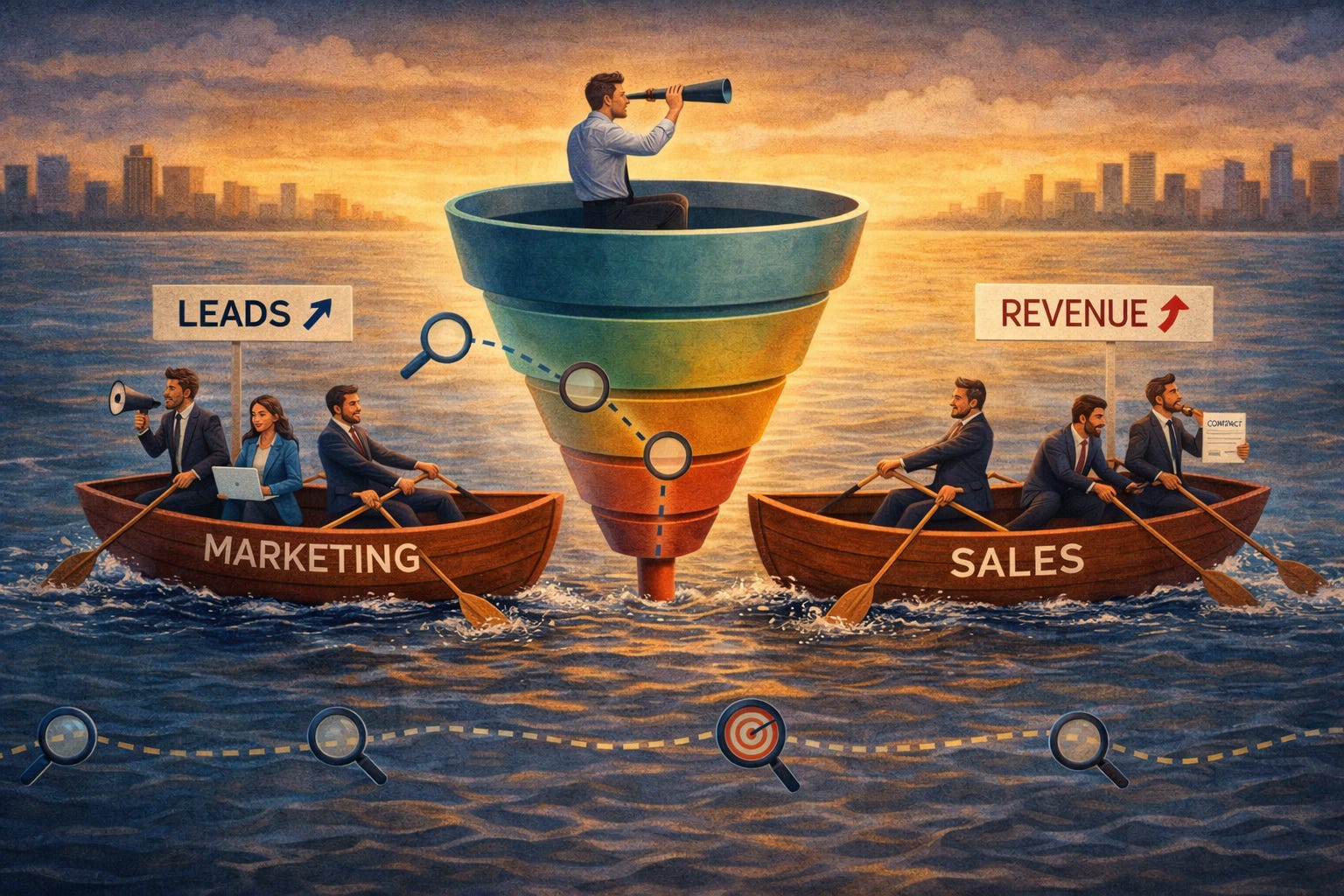
3. Analyze the entire funnel: When each team focuses on their own slice, nobody sees the full picture. The funnel needs someone with the fluency to connect the dots across every stage and find where the real leverage is. When that’s in place, small improvements compound into something much larger than any single breakthrough could achieve alone.
Why the chain matters: The failure mode is sequential. Misaligned goals kill cross-functional thinking. Without that, nobody looks at the full funnel. And without full funnel visibility, local wins don’t add up to a global one.
Why Most Companies Get This Wrong
Most founders or CEOs, if prompted, will say: “This makes sense, we already do this.” In my experience, proper implementation is actually rare.
The most common approach is reasonable on the surface: hire a strong CMO or CRO and task them with coordinating a team of best-in-class specialists. It sounds right. In practice, it breaks down in three predictable ways.
The senior leader lacks the tactical fluency to mediate tradeoffs: Many CMOs and CROs come from management consulting, brand management, or traditional sales backgrounds. They bring genuine strategic value, but modern GTM requires hands-on fluency across paid acquisition, conversion optimization, and sales ops that those backgrounds don’t always develop. Without it, they can’t evaluate tradeoffs, hold specialists accountable, or identify when something isn’t working.

The data they’re working from is often wrong: I’d estimate 95% of the companies I’ve worked with, including many that have raised $50 million or more, have meaningful tracking and analytics issues. Decisions at the senior level, however thoughtfully made, are often based on flawed inputs.
The specialists know their domain but not how to connect it to the broader outcome: There’s a meaningful difference between driving KPIs within a narrow domain and using that domain to drive cross-functional outcomes. A great SEO hire will drive traffic, but if their strategy isn’t calibrated to attract the right ICP, that traffic won’t convert to pipeline. This kind of specialist is rarely able to be retrained for the latter. It’s a fundamentally different orientation, not just a skill gap.

What This Looks Like in Practice
The most impactful GTM work I’ve done hasn’t come from optimizing within ad platforms. It’s come from going a few levels deeper than most people think to look.
Peppr → Limited first-party data made it hard to build effective audiences. I built a prospect dataset from scratch using Clay, targeting restaurant owners in core markets, then used it to seed lookalike audiences. Result: 10x improvement in cost per MQL.
Tutor Doctor → The ads were performing, but the landing experience was losing people. I replaced a long-form submission with a 3-step form, added testimonial photos, and surfaced media features to build credibility. Conversion doubled from 4% to 8%.

Pursuit → The problem wasn’t lead volume, it was attendance. I implemented Twilio-based SMS follow-ups post-form submission and Slack alerts for real-time triage of high-value prospects. Demo attendance went from 30% to 70%.
Dacast → The team was optimizing by cost per lead, which was pointing them in the wrong direction. Analyzing by cost per sale instead revealed that certain countries generated high lead volume but low intent. Redirecting budget took ROAS from 2x to 4x while scaling spend from $10k to $40k per month.
Relentless → I built a set of N8N automations to tighten the sales ops layer: a pre-call reminder with the Zoom link, real-time notifications when new slots opened, and a LinkedIn enrichment flow to score and prioritize leads. Together these added roughly 15 attended calls per week, helping me set a team record of 17 deals closed in a single month.
How to Apply This
The three principles are straightforward in theory but easy to let slip in practice. Here are some questions to help diagnose where things may be breaking down:
Optimize for end outcomes, not intermediate metrics
Are marketing and sales goaled on the same end result?
Where are you measuring activity instead of outcomes? Cost per lead instead of cost per sale, lead volume instead of pipeline quality?
Think cross-functionally
Does marketing know which lead sources actually close?
Does sales know where prospects are dropping off before they get on a call?
Is there a clear owner of the handoff between marketing and sales?
Analyze the entire funnel
When did you last audit every stage of the funnel?
Is there one person who can credibly speak to what’s happening at each stage?
Conclusion
Good people and a decent product are necessary, but they’re not sufficient. What determines whether a GTM motion works is whether someone is connecting the dots across the entire funnel, holding every stage accountable to the same end outcome, and fixing the places where things are quietly falling apart. That role is harder to define than “CMO” or “Growth Lead,” which is probably why it’s so rarely filled well. In my experience, it’s the single biggest lever most companies aren’t pulling.
If you liked this content, please click the <3 button on Substack so I know which content to double down on.
TLDR Summary
Most companies don’t have a lead generation problem. They have a GTM structure problem. Marketing hits lead targets, sales runs their process, yet revenue underperforms because each function optimizes for its own metrics instead of shared outcomes. The solution is to treat GTM as a connected system, aligning teams around revenue, forcing cross-functional collaboration, and analyzing the entire funnel as a single unit.
Key Principles and Insights
1. Optimize for End Outcomes, Not Intermediate Metrics
The root of most GTM dysfunction is misaligned incentives.
Marketing optimizes for lead volume
Sales optimizes for close rates
The business needs revenue and ROI
When teams are not goaled on the same outcome, metrics get gamed and performance looks better than it actually is. Lead volume and lead quality often diverge, and without full-funnel accountability, inefficiencies compound.
2. Think Cross-Functionally
When goals are misaligned, collaboration breaks down.
Marketing stops caring after the lead is captured
Sales dismisses leads and builds parallel pipelines
No one shares insights or fixes drop-off points
High-performing teams treat GTM as a shared system. They actively exchange data, align on what “good” looks like, and work together to improve conversion across stages.
3. Analyze the Entire Funnel
Most teams operate in silos, optimizing their slice of the funnel. The result is local improvements that do not translate into global gains.
The highest leverage comes from:
Connecting data across every stage
Identifying where prospects actually drop off
Making small, coordinated improvements that compound
Without full-funnel visibility, even strong execution produces mediocre results.
Why Most Companies Get This Wrong
Even when leaders understand this conceptually, execution breaks down due to three core issues:
Lack of tactical fluency: Senior leaders cannot effectively evaluate tradeoffs across marketing, conversion, and sales ops
Bad data: Most companies have flawed tracking, leading to incorrect decisions
Specialist silos: Experts optimize within their domain but fail to connect their work to business outcomes
This creates a system where everyone is performing well individually, but the system itself fails.
What This Looks Like in Practice
The biggest gains rarely come from optimizing a single channel. They come from fixing structural bottlenecks:
Building better datasets to improve targeting and dramatically reduce CAC
Improving landing page conversion to unlock existing demand
Fixing follow-up systems to increase attendance and close rates
Shifting optimization from cost per lead to cost per sale
Implementing lead scoring and prioritization to maximize sales efficiency
In each case, the leverage comes from connecting multiple parts of the funnel, not optimizing in isolation.
Conclusion
GTM success is not about better tactics. It is about better structure.
Companies that win align marketing and sales around the same outcome, think cross-functionally, and continuously analyze the full funnel. The biggest opportunity is not hiring more specialists or generating more leads. It is having someone who can connect the dots, identify where the system is breaking, and fix it end to end.
That role is rarely defined well, but it is often the highest leverage function in the business.
This is so good. You always have a way of calling out what’s actually broken beneath the surface. The part about everyone optimizing locally while the system underperforms really stuck with me, it’s such a common blind spot.
It makes you realize the real leverage isn’t more leads or better sales scripts, it’s having someone who can actually connect the dots across the whole funnel. Proud of you!!
Great post!
Point 2 in your framework has always been important, and is another topic that AI is accelerating. Transitioning marketing teams from SEO to GEO, and strategizing/coaching sales teams to manage the buyer's "trusted AI agent" stakeholder through the sales process is a growing topic of interest in our work.
Props on the workflow mentioned - I love me some N8N!